

Introduction
Choosing the right converting equipment can make or break your production efficiency. If you process large parent rolls of paper, film, or foil, you need to decide: a slitting and rewinding machine that cuts longitudinally into narrow rolls, or a cross-cutting machine that shears web materials into flat sheets. This guide compares both types across applications, output formats, and cost factors—helping you make a confident investment decision.
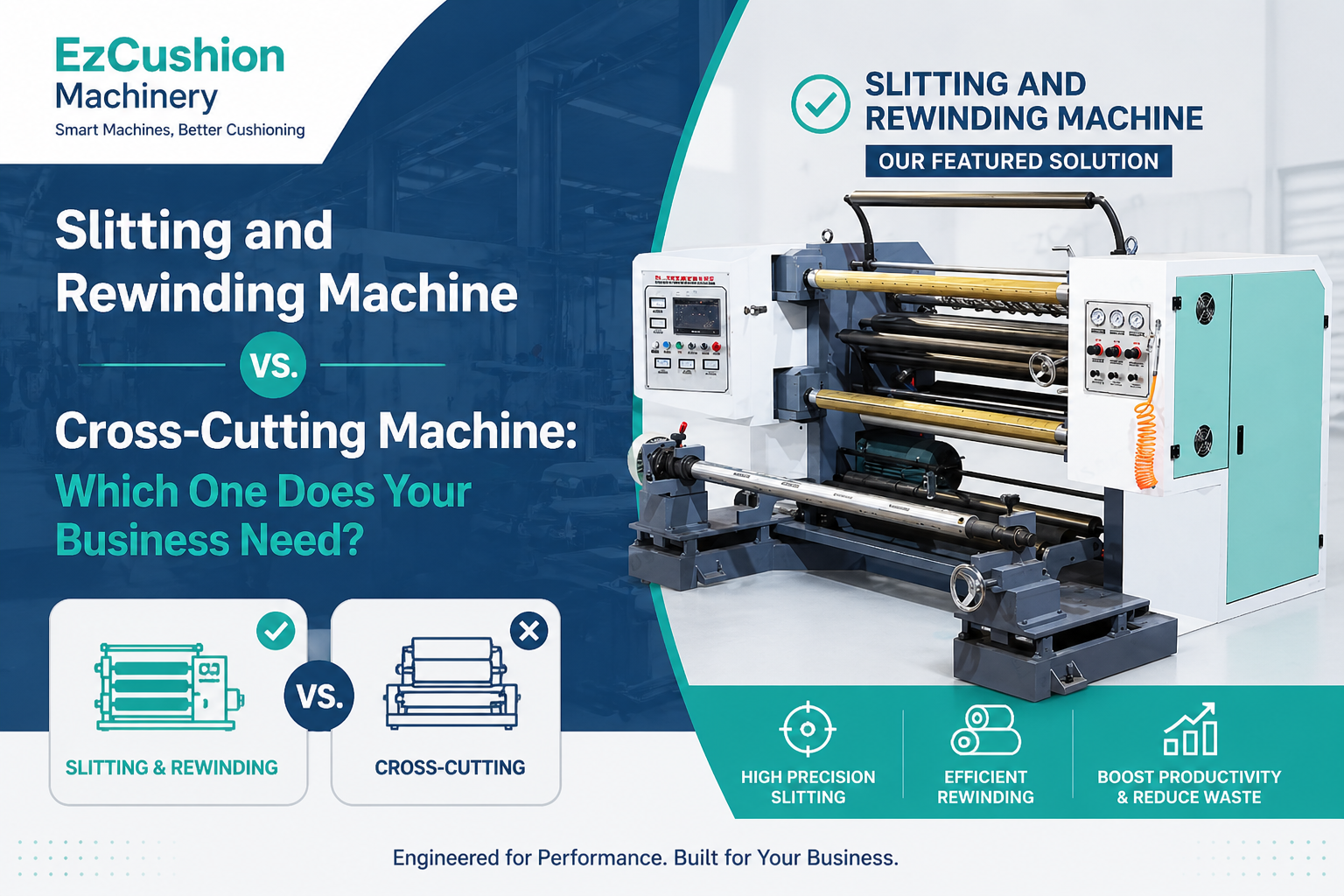
Slitting and Rewinding Machine vs Cross-Cutting Machine
| Feature | Slitting and Rewinding Machine | Cross-Cutting Machine |
|---|---|---|
| Primary Function | Slits a wide web longitudinally into multiple narrower strips, then rewinds them into individual rolls | Cuts a moving web transversely into discrete sheets or pads of a set length |
| Output Format | Narrow rolls (finished goods ready for dispensing, printing, or downstream converting) | Flat sheets, pads, or stacks (ready for packaging, forming, or further converting) |
| Cut Direction | Longitudinal (along the machine/web direction) | Transverse (across the machine/web direction) |
| Typical Applications | Thermal paper rolls, gift wrap rolls, adhesive tapes, labels, packaging films, foil rolls, tissue rolls, and slitting parent reels for printers or converters | Sheets for packaging boxes, cardboard blanks, paper pads, notebook pages, sign boards, printing paper sheets, and plastic sheet cutting |
| Material Suitability | Handles a wide range—thin films, coated papers, laminates, nonwovens, metal foils, and adhesive materials | Excellent for rigid sheets, heavy cardboard, thicker paperboard, and materials requiring precise length control |
| Production Speed | Typically very high (300–800 m/min) for continuous roll production | Moderate to high; speed often limited by sheet length, stacking quality, and downstream handling |
| Key Complexity Factor | Tension control across multiple slit strands; differential rewinding to handle width variations | Accurate length measurement and clean cut perpendicular to web direction; stack integrity for sheet output |
| Primary Cost Driver | Number of slitting stations, rewind shafts (duplex vs simplex), automation level (auto turret, laser alignment, closed-loop tension) | Cutting width, stacking system (pallets or piles), cross-cutting mechanism (rotary knife, guillotine, or flying shear) |
What Each Machine Does – The Core Difference Explained
The fundamental distinction lies in the direction of cut and the form of the output. A slitting and rewinding machine is designed to take a wide master roll—commonly called a jumbo roll or parent roll—and slice it lengthwise into multiple narrower ribbons, which are then rewound onto new cores to form individual finished rolls. In contrast, a cross-cutting machine cuts across the web (transversely) at predetermined intervals to produce individual sheets, pads, or stacks of a specific length, with no rewinding function involved.
Understanding this distinction is critical because the two machines serve entirely different stages of the converting workflow. For manufacturers who produce rolls of thermal paper for cash registers, rolls of gift wrap for retailers, or rolls of kraft tape for packaging lines, a slitting and rewinding machine is indispensable. Conversely, businesses that convert parent rolls into sheets—for example, cardboard boxes, notebook paper, packaging inserts, or printed sheets—will require a cross-cutting machine. And in many high-volume operations, both machines are deployed in sequence: the slitter rewinder first splits the jumbo roll into manageable widths, and then a separate cross-cutter or sheeter converts those narrower rolls into sheets.
The material characteristics also drive the choice. Slitting and rewinding machines excel on thin, flexible webs that require precise tension control to prevent stretching, telescoping, or wrinkling. Cross-cutting machines, meanwhile, are more forgiving on rigid substrates but impose stricter demands on length measurement accuracy and cut squareness.
Which One Does Your Business Need?
Before making any equipment purchase, work through these three decision drivers. The answers will tell you whether a slitting and rewinding machine, a cross-cutting machine, or both belong on your factory floor.
Question One: What is your output format? If your customers order narrow rolls for dispensing, you need a slitting and rewinding machine. If they order flat sheets or pads, you need a cross-cutting machine. If you currently outsource one of these operations but handle the other in-house, calculate the volume you are sending outside—the payback period on bringing that operation internal may be shorter than you think.
Question Two: What materials do you run, and what is the weekly volume? Slitting and rewinding machines handle a broader material range—from 6-micron films to 500-micron paperboard—but they are most cost-effective when processing continuous, high-volume runs of the same or similar widths. Cross-cutting machines are suitable for shorter runs where sheet format is required, but changeover times between different sheet lengths can eat into productivity. Many converters use a duplex slitter rewinder for roll production and a separate sheeter for sheet production, keeping each line optimized for its specific task.
Question Three: What is your space and labor situation? A slitting and rewinding machinetypically requires dedicated floor space for unwinding, slitting, rewinding, and roll handling, plus trained operators who understand tension control and knife alignment. Cross-cutting machines often have a smaller footprint for the same web width, but they require downstream space for stack accumulation and palletizing. If you are space-constrained, consider whether an integrated slitting-and-sheeting line might consolidate two operations into one.
Ultimately, the decision is not which machine is “better”—neither is superior in absolute terms—but which machine aligns with your product mix, customer requirements, and long-term growth plan.
FAQs
1. Can I slitt and cross-cut on the same machine? Yes—integrated slitting and cross-cutting combination lines exist, but they are specialized. Most converters prefer separate slitting and rewinding machine and cross-cutter for dedicated, high-volume efficiency. Combination units are best for space-limited shops with moderate mixed output.
2. Which machine is more expensive to buy and run? A high-end slitting and rewinding machinewith automatic features typically costs more upfront than a basic cross-cutter of similar width. However, per-unit converting costs depend entirely on your material, run length, and labor. Always calculate cost per kilogram or per thousand sheets—machine price alone is misleading.
3. Can a slitter rewinder handle thick cardboard? Yes, but you must use the right slitting method. Score cutting (crush cut) is designed for thicker, rigid materials like cardboard and heavy paperboard. Sheer slitting is also possible but requires more frequent knife maintenance on heavy-gauge stock. Razor slitting is not suitable for thick cardboard.
4. How do I reduce waste on my slitter rewinder? Start with closed-loop tension control to eliminate edge wander and telescoping. Second, inspect and sharpen shear knives regularly—dull blades produce dust and burrs that reject finished rolls. Third, use laser core alignment systems to ensure each slit strand stays centered on its core. Consistent training for operators on these best practices delivers the biggest reduction.
5. Does EzCushion Machinery offer both slitter rewinders and cross-cutters? EzCushion Machinery specializes in high-performance slitting and rewinding machines engineered for precision, durability, and ease of operation. Visit Our Web to explore our solutions for paper, film, foil, and specialty materials. Contact our team to discuss custom configurations for your specific production requirements.
Conclusion
Choosing between a slitting and rewinding machine and a cross-cutting machine comes down to one simple question: roll or sheet? If your business delivers narrow rolls for dispensing, a quality slitter rewinder is non-negotiable. For flat sheets and stacks, a cross-cutting machine is the answer. Still unsure which solution fits your operation? Visit Our Web today to explore our full range of converting equipment. Contact us for a free consultation—we will help you match the right machine to your material, volume, and budget.


