

Introduction
f you work with large rolls of paper, film, or foam, a slitting rewinding machine is your key to higher productivity and less waste. The key advantages include roll slitting efficiency, precision slitting, and automated tension control – all of which lower your operating costs. At EzCushion Machiner, we build eco‑friendly slitter rewinders that help you convert master rolls into perfect finished rolls. Discover more at Our Web.
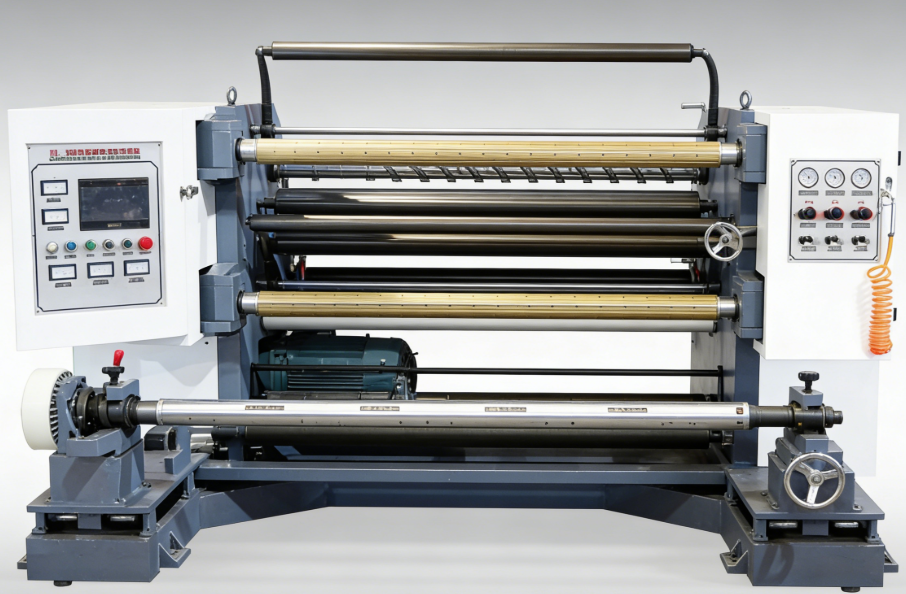
Core Advantages at a Glance
The table below outlines the six primary benefits you gain from a modern slitting rewinding machine. Each advantage directly impacts your production line’s speed, quality, and profitability.
| Advantage | What It Delivers | Impact on Your Business |
|---|---|---|
| High Throughput | Processes up to 500 m/min | Cuts labor hours per roll |
| Extreme Accuracy | Slit tolerance ±0.2 mm | Reduces scrap to under 1% |
| Material Versatility | Handles paper, film, foil, non‑wovens | One machine for many jobs |
| Automatic Tension Control | Constant web tension across all zones | Prevents wrinkles & telescoping |
| Quick Changeover | Adjusts for new widths in 10–15 min | Enables profitable short runs |
| Eco‑Friendly Operation | Low energy use, minimal edge trim | Supports sustainable packaging goals |
High Throughput – Slash Production Time
A quality slitter rewinder operates at speeds of 300 to 500 meters per minute, depending on the material. This high speed slitting capability means a 1000‑meter master roll is converted in just two to three minutes. The unwind station feeds the web continuously while the rewind shaft collects multiple narrow rolls simultaneously. Compared to manual or semi‑automatic methods, you can easily triple your output per shift. For a busy converter, that translates into more orders fulfilled on time and lower cost per meter.
Extreme Accuracy – Virtually Eliminate Waste
Precision is where a modern slitting rewinder truly outshines old equipment. Using shear or razor blades mounted on linear guides, the machine holds slit width tolerances as tight as ±0.2 mm. Ragged edges and uneven strips become a thing of the past. Consequently, usable material from each master roll jumps from 92‑95% to over 99%. That waste reduction converting directly saves raw material costs – often enough to pay for the machine within a year. For expensive substrates like coated paper or specialty films, the savings are even greater.
Material Versatility – One Machine for Dozens of Jobs
You no longer need separate equipment for paper, plastic films, and non‑wovens. A well‑designed slitter rewinder accepts interchangeable knife sets: razor slitting for thin films (12–50 microns), shear slitting for papers and foils, and crush slitting for non‑woven fabrics. The tension control system can be preset for each material type – from delicate tissue paper to sturdy kraft paper. This flexible material processing allows your shop to accept short‑run custom orders without tying up capital in multiple dedicated machines.
Automatic Tension Control – Defect Prevention Made Simple
One of the most underrated key advantages is closed‑loop tension control. Sensors at the unwind, slitting, and rewind zones measure web tension hundreds of times per second. If tension drifts, the system automatically adjusts the brake on the unwind stand or the motor on the rewind shaft. This tension control benefit prevents three common defects:
-
Wrinkles – caused by uneven slack
-
Stretching – caused by excessive pull
-
Telescoping – caused by uneven winding pressure
The result is that every finished roll is uniformly tight, with perfectly aligned layers – ready for automatic packaging lines.
Quick Changeover – Profitable Short Runs
Many converters avoid small orders because changeover takes hours. A modern slitter rewinder changes that. Quick changeover slitter design includes:
-
Easy‑access knife holders that slide and lock in seconds
-
Preset rewind shaft positions for different core widths
-
Digital recall of tension profiles for repeat jobs
Changeover between two different roll widths typically takes 10–15 minutes, and the first few meters of waste are minimal. This means you can run a 500‑meter custom job in the morning and a 10,000‑meter bulk order in the afternoon – both profitably.
Eco‑Friendly Operation – Support Green Packaging
As sustainability becomes a buying criterion, your equipment choices matter. Slitter rewinders from EzCushion Machiner are designed with eco‑friendly converting in mind:
-
Low energy consumption – servo drives only draw power when running
-
Minimal edge trim – precision slitting leaves only a few millimeters of waste per roll
-
Compatible with recycled materials – handles kraft paper and recycled films without issues
Additionally, the compact finished rolls reduce shipping volume and storage space, lowering your overall carbon footprint. For customers who demand sustainable packaging, being able to say “our slitting process generates under 1% waste” is a powerful sales advantage.
FAQs
1. How often do slitting blades need replacement?
Blade life depends on material and run length. For paper, shear blades typically last 3–6 months; razor blades for film may need replacement every 1–3 months. Daily visual checks are recommended.
2. Can a slitter rewinder handle thick materials like cardboard?
Yes, but only up to about 1.5 mm thickness for most industrial models. Thicker boards require a separate slitting machine. Always check the machine’s specified capacity.
3. Does automatic tension control work for stretch films?
Absolutely. In fact, stretch films demand active tension control because they are highly elastic. The system adjusts continuously to maintain constant web tension without over‑stretching.
4. What is the typical energy consumption of a slitter rewinder?
A medium‑sized machine (1.6 m web width) draws about 5–8 kW during operation – similar to a large oven. Standby power is near zero thanks to servo drive technology.
5. Is special training required to operate the machine?
Basic operation takes 1–2 days of training. Advanced features (tension profiles, knife setup) require another 2–3 days. Most manufacturers, including EzCushion, provide on‑site or video training.
6. Can I run very small batches, e.g., 200 meters?
Yes, with quick changeover features. The waste during setup is typically only 5–10 meters, so a 200‑meter run is still economical – perfect for sample rolls or custom sizes.
7. How noisy is a slitter rewinder during operation?
Modern machines with acoustic enclosures operate at 75–80 dB – about the same as a vacuum cleaner. Shear slitting is quieter than razor slitting. Hearing protection is recommended for extended exposure.
Conclusion
n summary, the key advantages you should know about a slitting rewinding machine are: higher throughput, extreme precision, material versatility, automatic tension control, quick changeover, and eco‑friendly operation. These benefits lower your costs, improve product quality, and support sustainability.
Ready to upgrade your converting line? EzCushion Machiner offers reliable, high‑precision slitter rewinders tailored to your materials. Contact us today for a free consultation or quote.


