

Introduction
With global shipping label production surging as e-commerce volumes climb, converters face intense pressure to slit and rewind jumbo rolls into precisely sized, defect-free finished rolls faster than ever. A high-speed automatic slitting and rewinding machine eliminates manual inefficiencies, ensures consistent cut accuracy, and dramatically reduces downtime—delivering the throughput and reliability that modern label production demands.
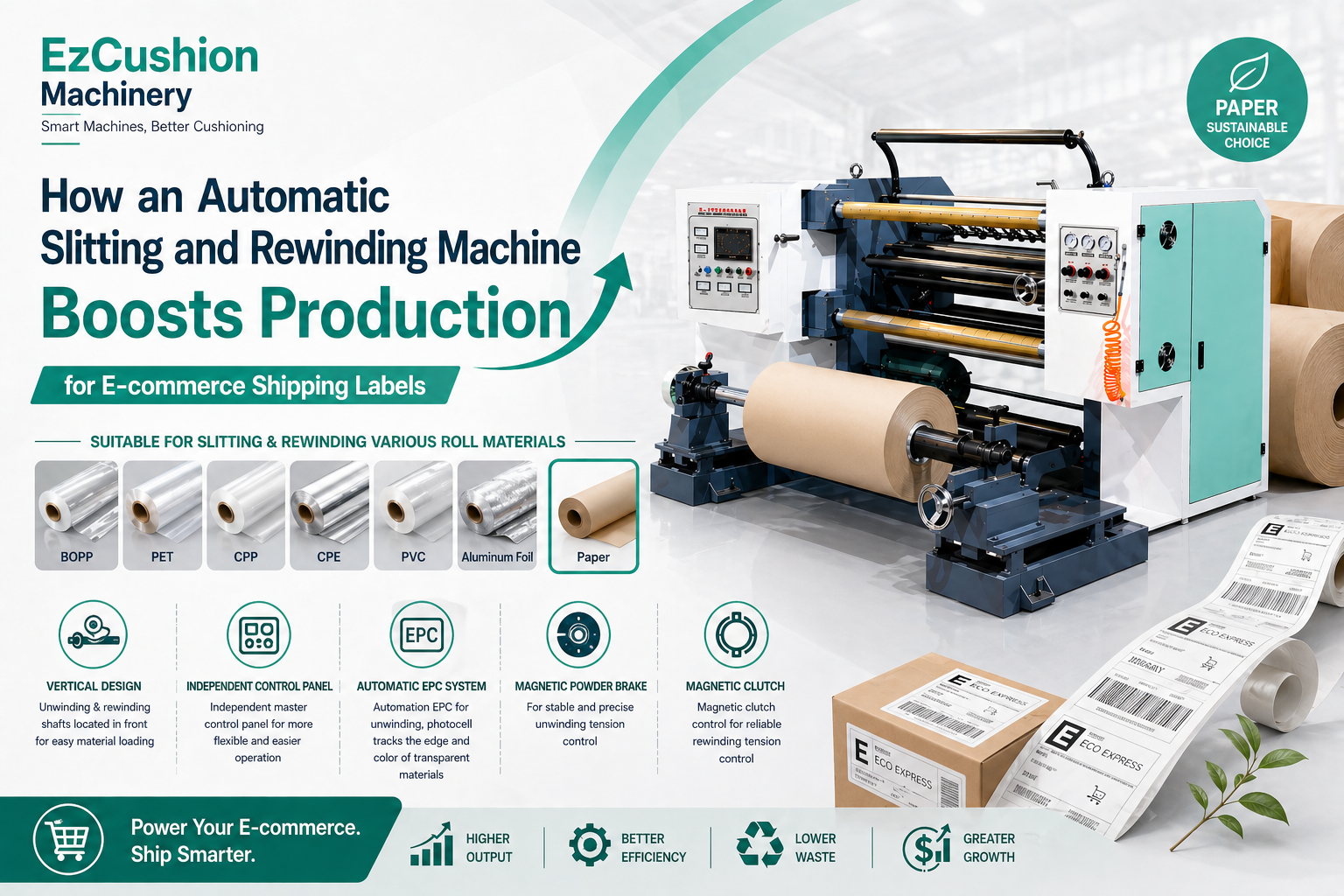
5 Key Ways Automation Boosts Shipping Label Production
| Performance Factor | Manual Slitter Rewinder | Automatic Slitting and Rewinding Machine | Productivity Gain |
|---|---|---|---|
| Production Speed | 50–100 m/min, operator-dependent | 300–600+ m/min, computer-controlled | Up to 6x faster |
| Setup & Changeover Time | 30–60 minutes (manual knife/ core adjustment) | 2–5 minutes (auto-positioning + recipe recall) | 85–95% reduction |
| Roll Consistency | Variable (operator fatigue & skill) | High (±0.1 mm cut tolerance) | Zero width drift |
| Labor Requirement | 2–3 operators per shift | 1 operator overseeing multiple machines | 60–70% labor reduction |
| Scrap/Waste Rate | 5–10% (setup + running waste) | <2% (closed-loop tension + auto correction) | 80% waste reduction |
1. Dramatically Increased Production Speed
The most immediate benefit of an automatic slitting and rewinding machine is its ability to operate at significantly higher speeds than manual alternatives. Automatic machines can consistently run at 300 to 600 meters per minute or more, depending on model and configuration, while manual machines are typically limited to 50–100 meters per minute due to operator constraints. A thermal paper slitter rewinder, for example, achieves stable running speeds of 500 to 600 m/min while maintaining precision, allowing converters to process the same volume in a fraction of the time.
This speed advantage translates directly into higher daily output. For a label converter processing multiple jumbo rolls per shift, the cumulative time savings from running at 500 m/min instead of 80 m/min can add hours of productive capacity each day—capacity that can be redirected to additional orders instead of extended shifts.
2. Precision Cutting with Tight Tolerances
Shipping labels require precise width consistency to feed correctly through automated applicators, thermal printers, and sorting systems. Even minor width variations can cause jams, misreads, and rejected shipments. An automatic slitting and rewinding machine maintains cut accuracy within ±0.1 mm tolerance through closed-loop control systems that monitor and adjust slitting parameters in real time.
Automatic machines use advanced control systems and sensors to provide consistent, accurate results even at high speeds, maintaining a high level of precision that manual operators cannot sustain across a full shift. For shear slitting operations, this translates into uniform roll density, clean edges, and stable shape from the core to the outer layer, ensuring that every finished roll meets customer specifications.
3. Rapid Changeovers and Recipe Reusability
Frequent changeovers between different label widths, roll diameters, and material types traditionally consume hours of unproductive downtime. Automatic machines eliminate this waste through digital knife positioning and recipe storage. Operators input job parameters—slit widths, roll diameters, tension levels, and winding pressure—through a touchscreen or control panel, and the machine automatically positions knives, sets tension, and configures rewind parameters without manual intervention.
Many automatic systems also support recipe storage, allowing operators to recall previous jobs with a single command, shortening setup time from half an hour to just minutes while eliminating the risk of human error from misreading measurements or incorrectly setting knives. For businesses running multiple label product lines, this quick-change capability transforms the economics of short-run production.
4. Lower Labor Costs and Reduced Operator Dependency
A manual slitter rewinder requires a dedicated operator to monitor and control the entire slitting and rewinding process continuously throughout the shift, with two to three operators often needed per machine to manage loading, unloading, and quality checks. Automatic slitting rewinders, by contrast, incorporate advanced technology that reduces manual labor requirements while enhancing product quality, enabling one operator to oversee multiple machines running simultaneously.
This automation also substantially reduces the impact of operator fatigue and shift changes on output quality. Manual systems often generate more waste during extended operation, especially when material sensitivity is high, whereas automatic machines maintain consistent performance regardless of shift timing.
5. Closed-Loop Tension Control for Defect-Free Rolls
Poor tension control is the primary cause of telescoping rolls, wrinkled edges, broken webs, and wound-in dust—all of which render finished label rolls unsaleable. An automatic slitting and rewinding machine uses closed-loop tension systems with load cells, dancer rollers, and servo drives to maintain web tension within ±2% of the setpoint, regardless of roll diameter changes or speed variations.
This tension stability is particularly critical for thermal papers and pressure-sensitive label stocks, which have heat-sensitive coatings and adhesives that can be damaged by excessive heat from friction or improper tension. By maintaining precise tension control, automatic machines prevent stretching, wrinkling, or breaks during high-volume production, ensuring that finished rolls are uniformly tight, perfectly aligned, and free of edge damage from start to core.
6. Integrated Quality Inspection for Zero Defects
Modern automatic slitting and rewinding machines can be equipped with vision inspection systems—such as Luster cameras or 100% fault detection—that automatically detect and reject defective labels before they reach the finished roll. This capability is especially valuable for shipping labels, where barcode readability and print clarity are mission-critical for logistics operations.
Inspection-enabled machines stop faulty products automatically on an inspection table for operator review, ensuring that no defective labels proceed to the customer. For high-volume e-commerce label producers, integrating 100% inspection directly into the slitting-rewinding process eliminates the need for separate offline inspection, streamlining quality control and reducing handling costs.
Why E-commerce Shipping Label Production Demands Automation
The global shipping label market was valued at approximately USD 9.87 billion in 2025, with projections reaching USD 15.63 billion by 2032, driven by accelerating e-commerce activities, cross-border trade, and stringent logistics labeling regulations. Thermal labels alone now account for over 65% of market share due to their cost-effectiveness and print-on-demand capabilities. For label converters serving major logistics providers that handle over 20 million daily parcels, the ability to produce consistent, defect-free rolls at high volume is no longer optional—it is a competitive necessity.
A modern automatic slitting and rewinding machine directly addresses this production challenge. Equipped with advanced sensors, PLC controls, and motor-driven adjustments, these machines perform cutting and rewinding with minimal human intervention, enabling higher throughput, reduced waste, and consistent product quality that manual systems simply cannot match at scale.
FAQs
1. Can an automatic slitter rewinder handle pressure-sensitive adhesive labels without sticking? Yes—rotary shear slitting with controlled blade overlap minimizes adhesive squeeze-out, keeping blades clean and preventing material sticking.
2. What is the typical payback period for upgrading from manual to automatic? Most label converters recover the investment within 12–18 months through labor savings, reduced scrap, and increased daily output.
3. How does blade temperature affect thermal label slitting quality? Excessive heat damages heat-sensitive coatings; automatic machines maintain blade temperature below 40°C and cool blades before running thermal papers to prevent coating damage.
4. Can an automatic slitter rewinder handle multiple label widths on the same job? Yes—differential rewind shafts allow each individual slit strand to be wound at its optimal tension, accommodating different widths and material calipers simultaneously on the same run.
5. How does EzCushion support e-commerce label converting? EzCushion offers automatic slitter rewinders with closed-loop tension control, recipe storage, and rapid changeover systems purpose-built for high-volume label production—delivering the speed and accuracy e-commerce converters demand.
Conclusion
As shipping label demand accelerates with e-commerce growth, the choice between manual and automatic slitting becomes a decisive competitive factor. An automatic slitting and rewinding machine delivers the speed, precision, and labor efficiency required to meet rising order volumes while minimizing waste and rework. Ready to future-proof your label production line? Visit EzCushion Machinery today to explore our automatic slitting and rewinding solutions. Contact us now for a free productivity assessment tailored to your shipping label converting needs.


