

Introduction
Running a slitting and rewinding machine efficiently is the backbone of high-quality luxury gift wrap production. Whether you are converting metallic foils or textured linen blends, mastering tension control, blade selection, and material tracking directly cuts waste and preserves that premium touch. At EzCushion Machinery, we’ve seen that the best slitting and rewinding operations share four core habits which transform the raw jumbo roll into perfectly wound, sell-ready gift wrap rolls.
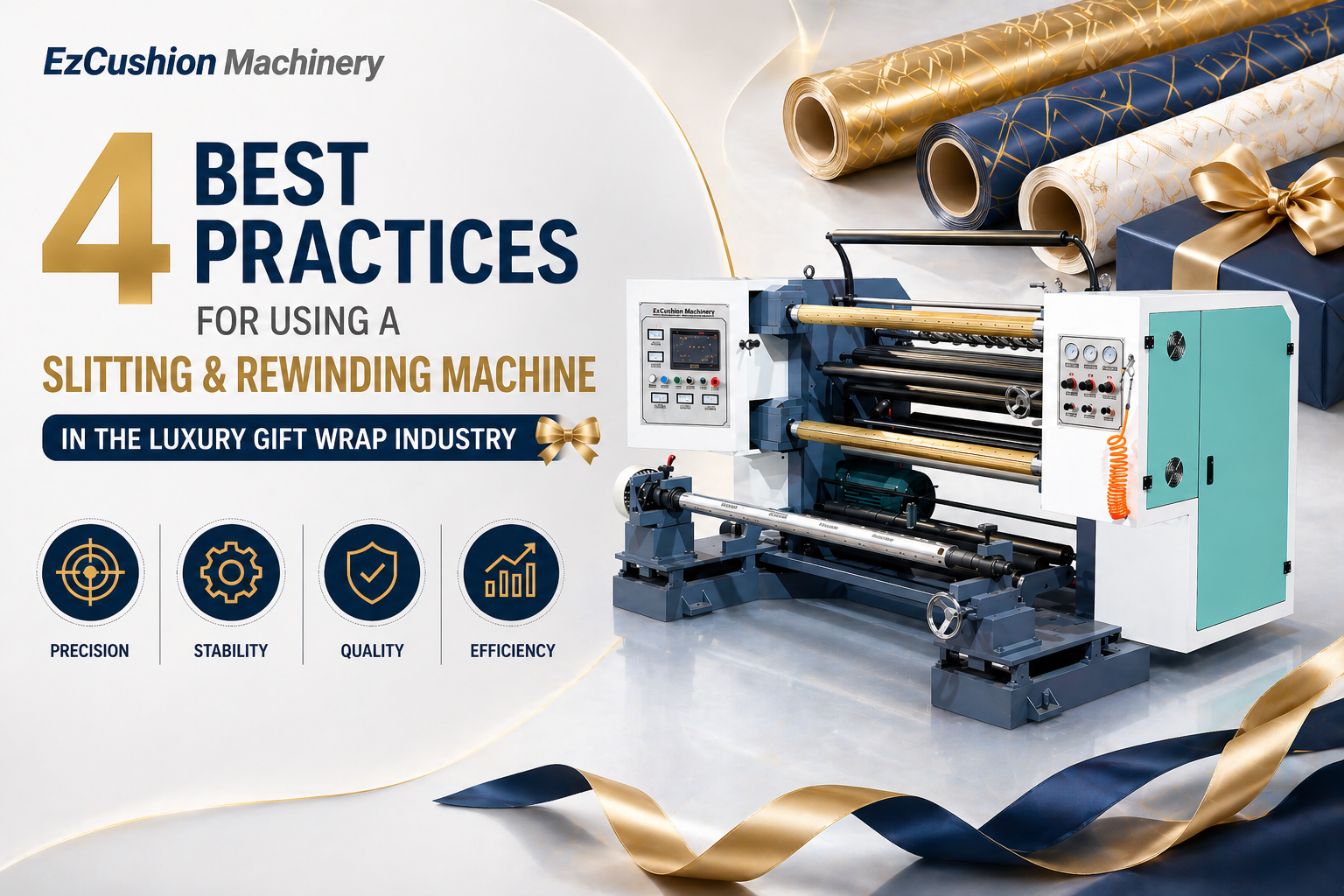
The Four Best Practices
| Best Practice | Why It Matters | Key Tools & Indicators |
|---|---|---|
| Master Tension Control | Prevents wrinkling, telescoping, and material distortion to preserve print registration and finish. | Closed-loop control, taper tension algorithms, load cells, magnetic clutches, and brake systems. |
| Select the Right Slitting Method | Ensures clean edges tailored to the material; straight razor for thin films, shear for paperboard, score for easy tear wraps. | Blade type (razor, shear, score), holder alignment, cutting angle, and overlap settings. |
| Align Rolls and Maintain Blades | Removes axial walk-off and edge burrs; directly reduces dusty fiber waste and finished roll “annual tree ring” effects. | Alignment sensors, core chucks, blade sharpness logs, and vibration analysis at the knife station. |
| Automate Roll Transfer and Web Guiding | Guarantees consistent inner‑core wraps and straight slit‑to‑wind tracking at high speeds; eliminates fold‑over tails. | Turret transfer stations, laser core positioners, trim removal vacuums, and photoelectric web guides. |
1. Master Tension Control for Wrinkle‑Free Luxury Wraps
Controlling the pulling force on the material web is the single most critical factor for producing gift wrap rolls that are tight, flat, and free of distortions. Luxury gift wrap papers often carry delicate coatings, metallic foils, or heavy linen textures, all of which react poorly to uneven tension. When the slitting and rewinding machine applies too much tension, the material stretches, causing printed patterns to misregister or the foil to craze. Too little tension, on the other hand, produces loose, telescoping rolls that are impossible to handle or sell wholesale. Modern closed‑loop tension systems that combine load‑cells, taper‑control algorithms, and magnetic brakes automatically reduce the winding pull as the roll diameter grows, ensuring uniform density from core to outer layer. For multi‑roll slitting, having independent rewind shaft zones lets one roll receive lighter tension while a wider adjacent roll stays firm – a necessity when producing multiple gift wrap widths from a single parent roll. Operators who calibrate tension per material type and run weekly sensor checks eliminate the vast majority of edge weave and “off‑core” defects before they ever appear on the finished pallet.
2. Select the Right Slitting Method for Clean, Dust‑Free Edges
The aesthetic of luxury gift wrap demands razor‑sharp, lint‑free edges. Dull or mismatched blades produce ragged edges, abrasive dust, and micro‑tears that ruin the unboxing experience. Understanding the three primary slitting methods is essential. Razor slitting uses thin, disposable blades and works beautifully on thin PET films, OPP laminates, and lightweight tissue wraps where speed and low dust are paramount. Shear slitting employs a pair of rotary knives that cut like scissors and is the preferred choice for heavy paperboard gift wrap, duplex paper, or any material thicker than 200gsm; it delivers a smooth, compressed edge but requires precise alignment and more frequent knife maintenance. Score slitting presses a circular blade against a hardened anvil to create perforations or score lines, ideal for gift wrap that must tear cleanly along a guide line. In a typical slitting‑rewinding shift, a luxury converter might run metallic foil prints that call for razor slitting, a heavy matte linen paper that needs shear knives, and a seasonal kraft line with a tear strip that uses score slitting – all on the same machine. Maintaining separate blade sets for each material family and logging blade‐change intervals by footage produced, not calendar days, keeps every edge museum‑quality.
3. Align Rolls and Maintain Blades to Eliminate Waste
Even a perfectly tuned tension system will produce garbage output if the machine’s rollers are mis‑aligned or the slitter blades are chipped. Mis‑aligned guide rollers cause the gift wrap web to walk laterally, leading to “telescoped” rolls where successive wraps slide past each other – a defect that directly destroys the value of a finished gift wrap roll. Worse, chipped or dull circular knives generate fine paper dust that embeds itself between wraps, scratching smooth finishes and creating the dreaded “annual tree ring” pattern on the roll side. The most effective luxury converters follow a strict weekly routine: inspect and lubricate every idler roller bearing, check the parallelism of the top and bottom shear knives with a feeler gauge, and use a digital blade sharpness tester on razor holders. They also verify core chuck tightness before every job – a loose core holder allows the paper tube to slip, causing exactly the kind of unstable winding that sends partial rolls to the scrap pile. When the slitting and rewinding machine runs for eight hours without a single dust‑related rejection, the alignment log usually shows three simple line items: all rollers squared, all blades sharp, and all chucks clamped.
4. Automate Roll Transfer and Web Guiding for Consistent Quality
The final two metres of a finished gift wrap roll – the inner end that the consumer first pulls – must be as perfect as the outer layers. Manual roll changeovers frequently introduce wrinkled starts, folded tails, or ragged cutoff edges that scream “seconds” to a premium buyer. Fully automatic turret transfer systems solve this by performing a straight‑line cut at the exact moment the roll reaches its target diameter, then instantly transferring the slit webs to brand‑new cores with a clean adhesive tail. Even more importantly, photoelectric web guiding sensors monitor the lateral position of the moving paper at up to hundreds of times per second, sending micro‑corrections to the unwind carriage. This keeps every slit strand perfectly centred on its respective core, eliminating the uneven edge build that plagues narrower gift wrap rolls. For luxury producers running high‑speed lines, laser core‑positioning systems paired with auto‑knife placement reduce set‑up time from thirty minutes to under sixty seconds, while integrated trim‑removal vacuums ensure that waste edge strips go directly to a baler rather than wrapping around a rewind shaft. When you add a data‑collection module that reports downtime and throughput to a central dashboard, the slitting and rewinding machine becomes not just a tool, but a profit centre that you can manage from anywhere.
FAQs
1. What is the most common defect in slitting luxury gift wrap?
Uneven edge cuts and telescoping rolls are most common. Both usually trace back to either dull razor blades or inconsistent unwind tension — fix the blade first, then recalibrate the tension control system.
2. How often should I sharpen shear slitting knives?
Stop waiting for failures. Change them every 150–200 operating hours or immediately when you see dust or micro‑nicks on the roll edges — reactive maintenance always costs more.
3. Can I slit both foil and eco‑friendly paper on the same machine?
Yes, but you must switch the slitting method. Use shear knives for thick paperboard and razor blades for thin foils — running both through the same blade set guarantees defects.
4. How does EzCushion help reduce material waste?
EzCushion machines integrate closed‑loop taper tension controls, laser core placement, and auto turret transfer. These work together to keep every wrap tight and every edge clean, eliminating scrap before it starts.
5. What’s the fastest way to check web alignment?
Paint two thin contrast lines across the full web width. After running for 30 seconds, stop and measure — if the lines shifted more than 2mm, your web guide needs immediate recalibration.
Conclusion
Premium luxury gift wrap rewards precision. Following these four best practices for your slitting and rewinding machine will dramatically reduce waste and deliver flawless rolls every time. Ready to upgrade your production line? Visit EzCushion Machinery today to explore our range of professional slitting and rewinding solutions tailored for the luxury packaging sector. Contact us now for a free consultation!


