

Introduction
To sell finished rolls on time and with exact repeatable width, you need a slitting and rewinding machine that runs fast without sacrificing tolerance. Yet many converters find that productivity stops improving beyond a certain point. The truth is that machine speed and finished‑roll accuracy are not fixed – they are governed by six controllable factors. Optimizing each one helps you unlock higher line speeds while maintaining slit accuracy down to ±0.1 mm.
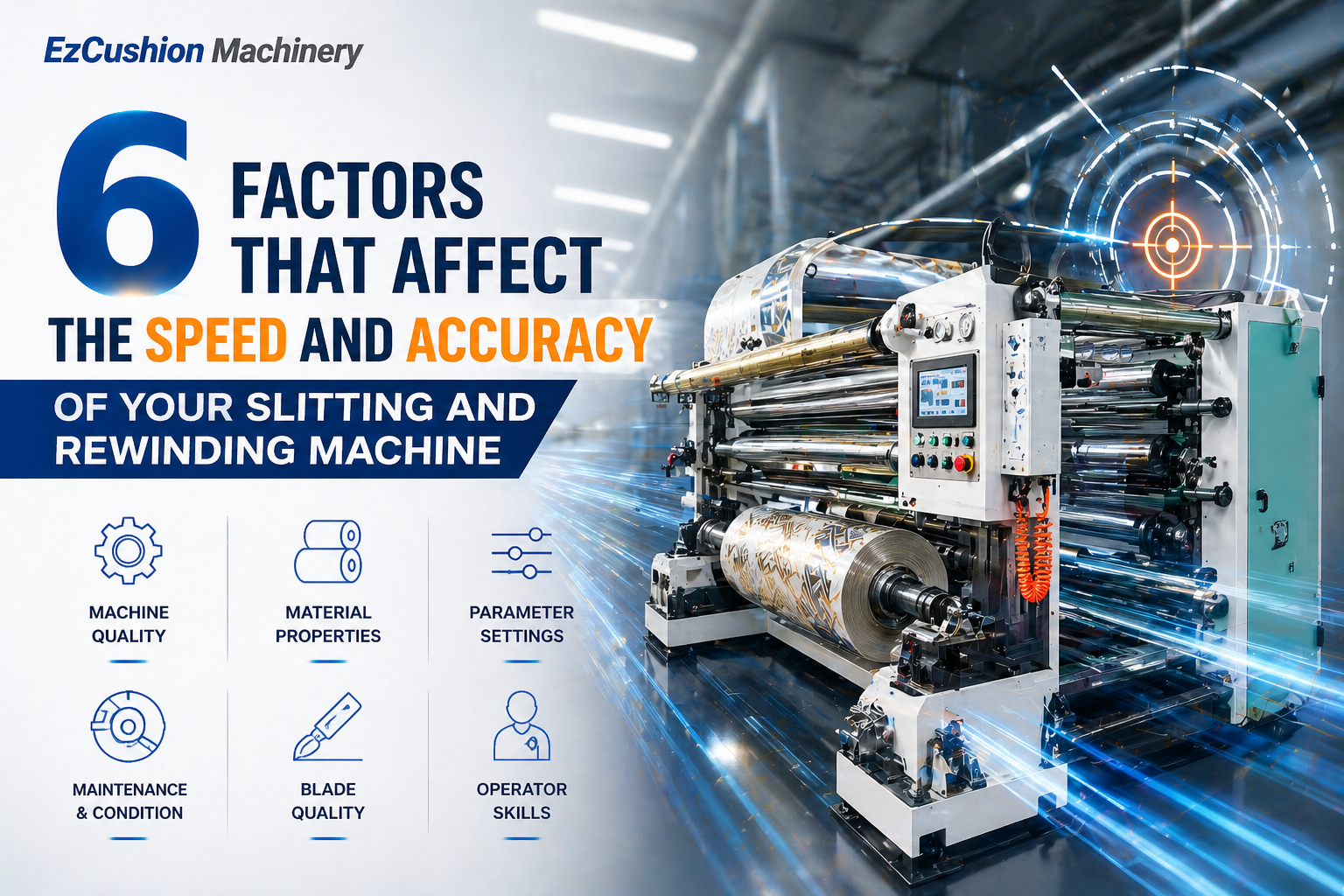
The Six Critical Factors
| Factor | Why It Affects Speed & Accuracy |
|---|---|
| Tension Control System | Directly determines web stability, preventing wrinkles, stretching, or breaks at high speed |
| Blade Sharpness & Wear | Dull blades create edge dust and burrs, forcing speed reduction to avoid tearing |
| Machine Alignment & Vibration | Mis‑aligned rollers and shafts introduce wobble that ruins width tolerance |
| Material Type & Characteristics | Hard/thick materials need slower speeds while thin films can often run faster |
| Automation Level & Setup | Manual positioning and frequent changeovers waste time and introduce human variance |
| Operator Skill & Maintenance | Even the best machine underperforms without proper care and trained handling |
1. Tension Control System – The Base of Every Slit
Unstable tension is the #1 destroyer of both speed and accuracy. If tension swings too high or too low, the web either stretches out of specification or slackens and loses edge registration. High‑quality wrap shear‑slitting demands that the web stays fully supported and under a controlled pull; any fluctuation shifts the material laterally, so the cut point drifts and finished roll widths vary. A modern closed‑loop tension system with a PID algorithm keeps web tension fluctuation within ≤±0.5 N, which prevents material stretching or deformation even when you push for higher line speeds. Without this stability, operators have no choice but to slow down dramatically to avoid crashes and rejects.
2. Blade Sharpness & Wear – The Cutting Edge of Speed
A dull blade forces a cruel trade‑off: either slow the speed to avoid tearing the material, or run fast and accept ragged cuts, dust, and dangerously high trim waste breakage. For shear slitting, periodic inspection after every 50 kilometers of cutting is necessary – tungsten carbide edges or ceramic blades need fresh sharpening at consistent intervals. Dull knives literally burn time: they increase side‑load force on the web, which can cause wavy cut lines and burrs, and every burr means a slowdown to clear the slitting zone. When you replace dull blades promptly, the slitting and rewinding machine can operate at its maximum design speed without clogging the trim removal system or sending defective rolls downstream.
3. Machine Alignment & Vibration – The Hidden Accuracy Killer
Imperceptible misalignment adds up into major tolerance failures. A guide roller that is out of square by even 0.05 mm/m leads to lateral “walking” of the web, causing telescoped rolls and slit‑edge wandering. On the cutter shaft, the allowable radial runout is extremely tight – typically ≤0.005 mm – because any excess runout makes the blade oscillate, producing scalloped cuts and width deviations that can exceed ±0.2 mm even though the machine control says everything is fine. Vibration from worn bearings, loose drive belts, or poor foundation isolation further degrades dimensional stability. Annual dynamic balance testing for high‑speed rollers (G2.5 standard) keeps those subtle shudders from turning into expensive width rejects.
4. Material Type & Characteristics – Know Your Substrate
Your slitting and rewinding machine can only run as fast as the material allows. Thick, rigid papers or heavy laminates require reduced slitting speed to prevent snapping, while thin films and light papers can often tolerate much higher speeds because they are more flexible. Material flatness is another key constraint: if the incoming parent roll has baggy edges or centre buckling, the web will not ride perfectly past the knives regardless of tension settings, making accurate slitting impossible except at crawl speed. Environmental humidity also plays a role; paper expands and contracts with moisture, so shopfloor temperature and humidity control (22±2°C, 50%±5% RH) helps maintain stable material dimensions and allows the machine to run consistently at targeted speeds without recalibration every hour.
5. Automation Level & Setup – Time That Is Not Running
Every minute spent on manual knife positioning or core alignment is a minute of zero output – and if the job is done manually, tiny positioning errors guarantee width variation. Automatic knife positioning systems reduce changeovers from an hour to a few minutes while delivering repeatable accuracy. For alignment, a laser core alignment system slashes setup time: two lasers (one on the rewind side and one on the slitting side) guide operators to align cores and knives precisely, eliminating guesswork and ensuring perfectly aligned edges every time. Machines that store setup recipes digitally can recall proven parameters in seconds, so short‑run jobs become profitable rather than a setup nightmare. The difference between a fully automated slitting and rewinding machine and a manual counterpart is often a 50% reduction in setup‑related downtime.
6. Operator Skill & Maintenance – The Human Factor
No machine exceeds the capabilities of its care team. Routine maintenance tasks – checking blade wear each shift, cleaning photoelectric sensors, verifying guide roller parallelism, and lubricating bearings – are often the difference between six‑figure scrap bills and smooth operations. Even simple daily inspections catch small problems before they become major crashes. Highly trained operators also understand how to match the machine’s speed curve to the material; they know when to reduce speed for fragile edges and when to push toward maximum throughput. When combined with proactive replacement of worn bearings and air shaft seals, skilled operation allows the slitting and rewinding machine to run at consistent high speed with accuracy that never drifts over a full shift.
FAQs
1. What is the fastest slitting method for high‑speed production?
Slitting Machine is generally the fastest method for thin films and light papers, but only when the web is perfectly stabilised with closed‑loop tension control. For heavy paperboard, shear slitting is somewhat slower but necessary for clean edges.
2. How do I verify if my tension control is accurate enough?
Check the deviation percentage: high‑precision systems keep tension fluctuation within ±1% of the setpoint. Monitor your finished roll ends for even density from core to outer wrap.
3. Does the machine’s maximum mechanical speed always equal actual production speed?
No – your real maximum is always limited by material properties, blade condition, and web flatness. The mechanical rating is only theoretical; actual speed is whatever your substrate tolerates without defect formation.
4. What width tolerance is realistic for a standard slitter rewinder?
With proper alignment and stable tension, expect ≤±0.1 mm for paper and ≤±0.2 mm for thin films. Below 0.1 mm generally requires wrap shear‑slitting with precision spacers and extremely rigid machine construction.
5. How does EzCushion help me balance speed and accuracy?
EzCushion machines integrate closed‑loop PID tension control, automatic knife positioning, and laser core alignment systems that together let you process more jobs per shift without ever drifting out of tolerance.
Conclusion
Six main factors control how fast and precisely your slitting and rewinding machine performs. By hardening tension control, maintaining sharp blades, calibrating alignment, matching speed to material, adding automation, and training your crew, you can eliminate waste and hit every tolerance target. Ready to run faster and cut cleaner? Visit EzCushion Machinery today to find the ideal slitting and rewinding solution for your production floor. Contact us now for a free performance assessment!


