

Introduction
The global paper bag market is expanding rapidly, driven by a global push for sustainable alternatives to single-use plastics. Paper bags are renewable, recyclable, and biodegradable, but producing them at scale requires eco-friendly manufacturing processes. A high-performance slitting and rewinding machine is indispensable to this effort—it cuts and rewinds large jumbo rolls of kraft paper into precise, narrower rolls that feed directly into paper bag forming equipment. Without it, achieving the perfect balance of roll quality, material efficiency, and sustainability is nearly impossible. Here are five reasons why a slitter rewinder is the backbone of a truly sustainable paper bag operation.
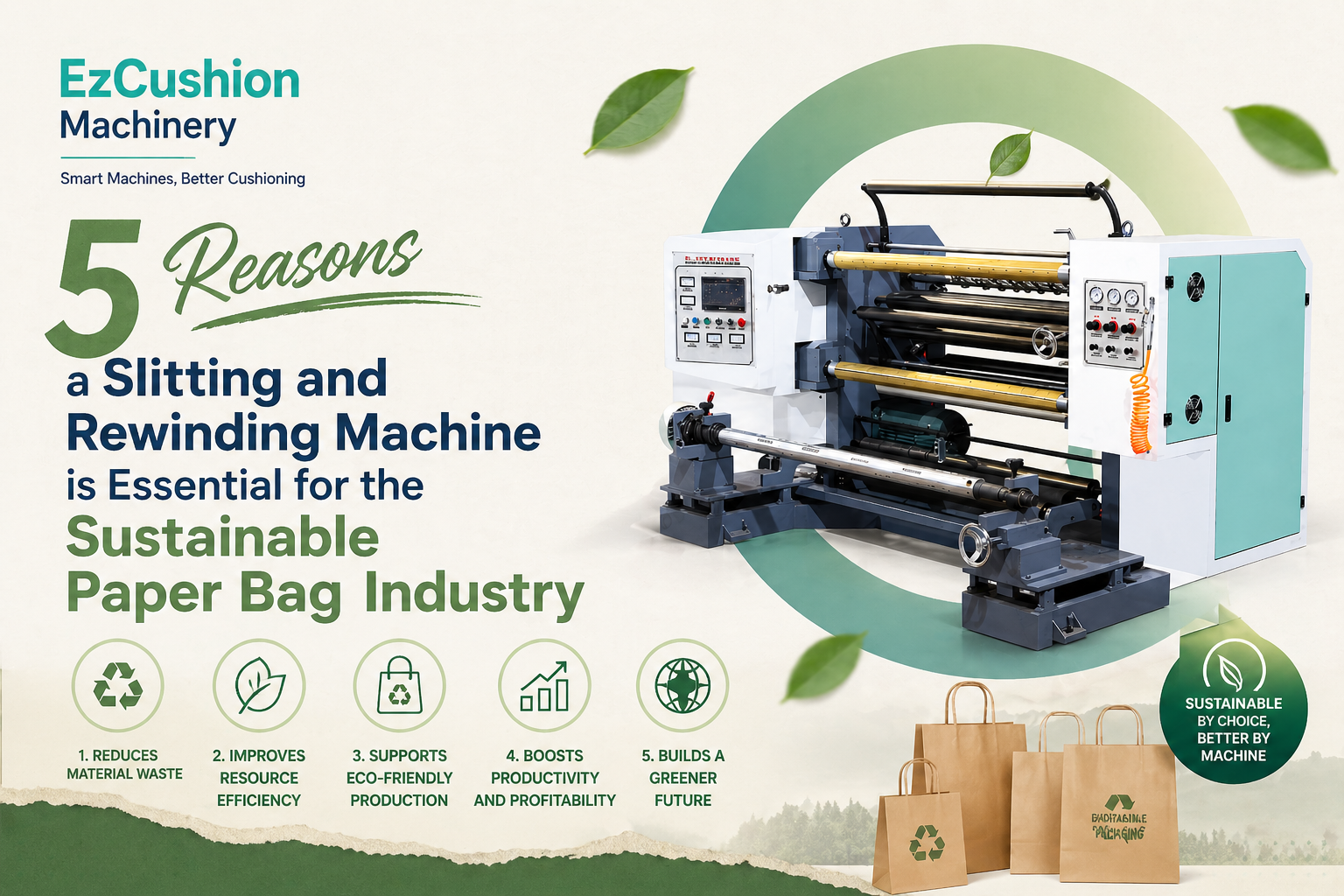
Why a Slitting and Rewinding Machine Matters for Sustainability
| Reason | Core Mechanism | Key Sustainability Outcome |
|---|---|---|
| 1. Minimizes Production Waste | Precision slitting (±0.1 mm) + edge‑trim reclamation systems | Up to 35–40% reduction in scrap sent to landfill |
| 2. Maximizes Material Utilization | Digital knife positioning and taper tension algorithms | Lower raw material consumption per bag; smaller forest footprint |
| 3. Improves Finished Roll Quality | Web guiding + differential rewind shafts | Prevents jams on bag lines; avoids energy‑wasting re‑runs |
| 4. Enables Recycled & Eco‑Papers | Shear/score slitting + antistatic & dust control | Allows high PCR content and alternative fibers |
| 5. Reduces Energy & Carbon Footprint | High speed + auto turret transfer + regenerative braking | Lower kWh per output roll; smaller carbon footprint |
1. Minimizes Production Waste Through Precision Cutting and Edge‑Trim Reclamation
The most immediate environmental gain from a slitting and rewinding machine comes from waste reduction. Traditional cutting methods produce ragged edges, width variations, and off‑spec rolls that often end up as scrap. Modern slitter rewinders achieve cut‑width tolerances as tight as ±0.1 mm, meaning nearly every millimeter of kraft paper is used. Beyond precision, integrated trim‑removal vacuums collect the outermost edge strips and automatically rewind them into secondary rolls for lower‑grade uses (e.g., void fill or protective wrap). This turns what was once landfill material into a revenue stream. For a paper bag manufacturer, this combination alone can slash total raw material consumption by double‑digit percentages while also cutting disposal costs.
2. Maximizes Material Utilization Through Accurate Width Specification
Sustainability is not only about reducing waste after cutting—it is about consuming less material from the start. A slitting and rewinding machine achieves this by delivering on‑demand roll widths that exactly match the dimensions required by downstream bag‑making equipment. Digital knife positioning lets operators enter the desired finished widths, and the machine automatically sets the blades to thousandth‑of‑inch accuracy. Meanwhile, closed‑loop taper tension algorithms reduce the winding pull as the roll diameter grows, eliminating wasteful over‑winding or loose cores. The result is that every parent jumbo roll yields the maximum possible number of usable finished rolls, lowering the consumption of virgin or recycled fiber per bag.
3. Improves Finished Roll Quality to Prevent Downstream Failures
A poorly wound roll—telescoped, cross‑wound, or wrinkled—will cause frequent jams, misfeeds, and rejects on the paper bag production line. Each jam forces a line stop, wastes the damaged section, and burns extra energy during restart. A slitting and rewinding machine engineered for quality prevents these failures. Load cells and photoelectric web guides keep the paper perfectly centered through the slitting zone. Differential rewind shafts allow each individual slit roll to be wound at its own optimal tension, compensating for natural caliper variations across the jumbo roll. The output: rolls that are uniformly tight, perfectly aligned, and free of edge damage. These rolls feed seamlessly into high‑speed bag formers, eliminating downtime and the waste of energy‑intensive re‑runs. This is sustainability through reliability—stopping waste before it happens.
4. Enables the Use of Recycled, Lightweight, and Alternative Eco‑Papers
For the paper bag industry to be truly sustainable, manufacturers must move beyond virgin kraft to incorporate post‑consumer recycled (PCR) fiber, agricultural residues, and alternative plant‑based papers. However, these materials often have shorter fiber lengths, variable caliper, and high moisture/static sensitivity—problems that cause dust, edge fray, and web breaks on general‑purpose cutters. A well‑specified slitting and rewinding machine is designed for these challenging substrates. Shear slitting (rotary blades) produces clean, compressed edges without shedding dust, even on low‑basis‑weight recycled paper. Score slitting (crush cutting) handles heavier boards. Additional features like antistatic bars and dust extraction hoods combat static and moisture swings. By seamlessly processing PCR kraft and eco‑papers, slitter rewinders allow bag manufacturers to confidently raise recycled content without sacrificing roll quality or line speed, meeting both regulations and consumer expectations for circular packaging.
5. Reduces Energy Consumption and Carbon Emissions Through Efficient Design
Energy efficiency is a rarely highlighted but critical sustainability benefit. A slitting and rewinding machine that is well designed consumes significantly less electricity per ton of finished paper than outdated equipment. High‑speed operation processes more paper per hour, reducing overhead (lighting, HVAC) per roll. Automated turret transfer systems complete roll changes in as little as 15 seconds, eliminating prolonged idling of motors and drives. Some energy‑forward models feature regenerative braking: when the machine decelerates, drive motors act as generators, converting kinetic energy back into electricity that can be used elsewhere in the facility. Over a year of high‑volume production, these savings can cut thousands of kilograms of CO₂ equivalent. For paper bag manufacturers facing rising energy costs and Scope 2 reporting pressure, upgrading to an energy‑efficient slitter rewinder is both an environmental and a financial imperative.
FAQs
1. Can a slitter rewinder handle 100% recycled kraft without dust? Yes, when equipped with shear slitting (rotary knives) and dust extraction hoods, it produces clean edges even on short‑fiber recycled paper.
2. How much waste can an upgraded slitter rewinder eliminate? Typically 25–40% waste reduction, thanks to ±0.1 mm cut tolerance and edge‑trim reclamation that turns scrap into secondary products.
3. Are energy‑efficient slitter rewinders cost‑effective? Yes; the 10–20% upfront premium often pays back in under 18 months through lower electricity bills and faster throughput.
4. What certifications should I look for? *CE/UL electrical safety, ISO energy management compliance, and the ability to run lightweight (40–80 gsm) papers to reduce fiber consumption.*
5. How does EzCushion support sustainable paper bag manufacturing? EzCushion builds slitter rewinders with dust‑free shear slitting, closed‑loop tension control, and high‑speed auto transfers to cut waste and energy use.
Conclusion
From reducing waste to enabling recycled fibers and lowering energy use, a slitting and rewinding machine is the hidden engine of sustainable paper bag production. Choosing the right machine is an investment in your environmental performance and regulatory readiness. Visit EzCushion Machinery today to explore our eco‑conscious slitting and rewinding solutions. Contact us for a free sustainability assessment of your converting line!


