

Introduction
Kraft paper is strong, recyclable, and widely used for protective packaging. However, its fiber structure and thickness variations demand a slitting and rewinding machine built for paper. Before you invest, check these 10 critical specifications to avoid costly mistakes. At EzCushion Machiner, we engineer slitter rewinders specifically for kraft paper applications. Learn more at Our Web.
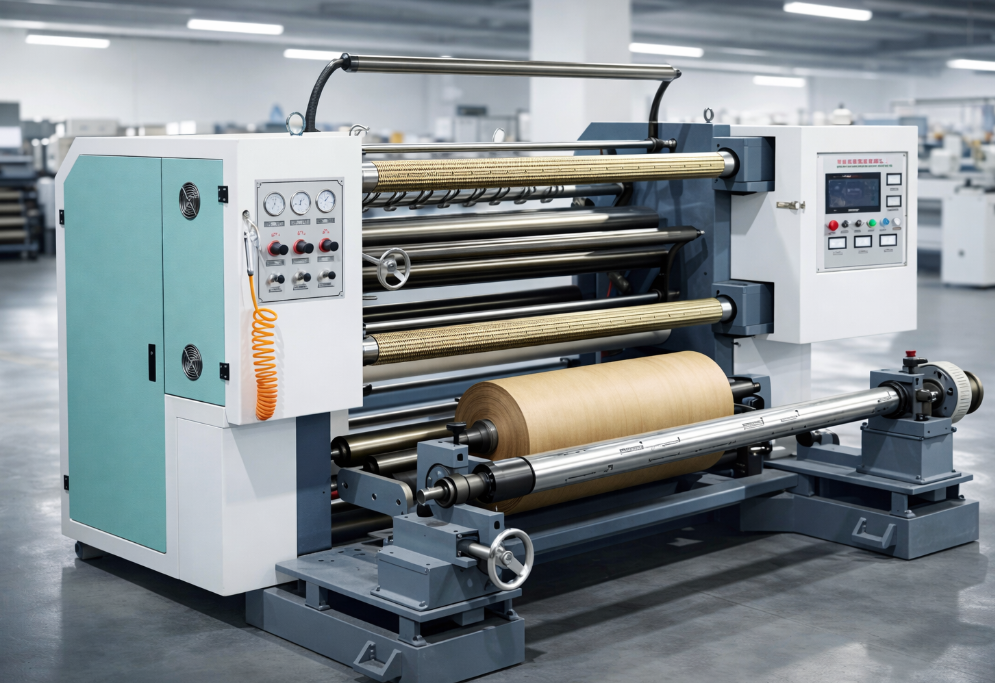
The 10 Must-Check Specifications at a Glance
The table below lists each specification, why it matters for kraft paper, and what value to look for. Use this as your pre-purchase checklist.
| # | Specification | Why It Matters for Kraft Paper | Target Value / Feature |
|---|---|---|---|
| 1 | Max Web Width | Must fit your largest master roll | ≥ 100 mm wider than max roll |
| 2 | Slitting Method | Kraft paper requires clean, dust-free cuts | Shear slitting (preferred) or razor |
| 3 | Knife Material | Paper fibers dull standard blades quickly | Tungsten carbide or HSS knives |
| 4 | Tension Control Type | Prevents stretching and tearing of kraft | Closed-loop with load cells |
| 5 | Unwind Brake System | Handles heavy paper rolls without inertia | Pneumatic or servo brake |
| 6 | Rewind Shaft Design | Avoids telescoping in narrow kraft rolls | Differential rewind shaft |
| 7 | Slitting Speed Range | Balance productivity with paper strength | 200–400 m/min (adjustable) |
| 8 | Core Chuck Type | Must grip kraft cores without crushing | Mechanical or air shaft with chucks |
| 9 | Dust Extraction | Kraft paper creates dust and fiber debris | Built-in vacuum or blower system |
| 10 | Machine Frame Rigidity | Vibrations cause crooked slits on paper | Heavy-duty welded steel frame |
Max Web Width – Fit Your Master Rolls
Kraft paper master rolls come in standard widths like 800 mm, 1200 mm, or 1600 mm. The machine’s maximum web width must be at least 100 mm wider than your widest roll to accommodate edge trim and web wandering. If you process 1500 mm rolls, choose a 1600 mm or 1700 mm machine. Going too narrow means you cannot use your largest inventory; too wide wastes floor space and money. Always verify the unwind stand can handle the roll’s outer diameter (often 600–1000 mm) and core diameter (typically 76 mm or 152 mm).
Slitting Method – Shear Slitting is Best for Kraft
For kraft paper, shear slitting is vastly superior to razor or crush methods. Shear slitting uses a rotating male blade and a female anvil (like scissors) that cuts the paper fibers cleanly without generating dust. Razor slitting, common for films, produces ragged edges and paper dust that contaminates your production area. Crush slitting compresses the paper edge, causing weak spots. A good kraft paper slitter will have adjustable shear knife holders that allow you to change slit widths quickly. Confirm that the machine includes both top and bottom knife shafts with easy access for resharpening.
Knife Material – Tungsten Carbide for Long Life
Standard steel knives dull within hours on abrasive kraft paper. Tungsten carbide or high-speed steel (HSS) knives retain sharpness much longer – often 3–6 months between regrinds. Some suppliers offer coated knives (e.g., titanium nitride) for even longer life. Ask the manufacturer about the knife material included in the base price. Also check the knife sharpening angle: for kraft paper, 20–25 degrees is ideal. Dull knives create stringy edges and increase motor load, so investing in quality knife material directly reduces downtime.
Tension Control Type – Closed-Loop is Non-Negotiable
Kraft paper stretches under high tension but tears easily if tension fluctuates. Closed-loop tension control with load cells and a servo-driven unwind brake maintains constant tension regardless of roll diameter. Open-loop systems (fixed brake pressure) cause tension to rise as the roll shrinks – leading to broken webs or stretched paper. For kraft paper, look for tension ranges of 5–50 N/m per cm width, adjustable digitally. This tension control benefit prevents telescoping, wrinkles, and the most hated defect: a sudden web break that stops production for 15 minutes.
Unwind Brake System – Handle Heavy Rolls Safely
Kraft paper master rolls can weigh 300–800 kg. The unwind brake must control this inertia smoothly, especially when stopping. Two common types:
-
Pneumatic brake – Uses air pressure to apply friction. Inexpensive but requires clean, dry air.
-
Servo brake – Uses a motor to regenerate energy. More expensive but provides precise, maintenance‑free control.
For kraft paper, a pneumatic brake with a constant tension controller works well for most shops. Ensure the brake has enough torque capacity – calculate by: torque (Nm) = roll weight (kg) × 9.8 × core radius (m) × 0.5.
Rewind Shaft Design – Differential Shaft for Narrow Rolls
When slitting a wide kraft roll into many narrow strips (e.g., 1600 mm into 80 mm rolls), small thickness variations across the web cause uneven roll hardness. A differential rewind shaft allows each core position to slip independently, compensating for these variations. The result: every finished roll has the same tightness, no loose layers or telescoping. Single-shaft designs are cheaper but produce poor-quality narrow rolls – unacceptable if you sell to automatic packaging lines. For kraft paper, always choose differential winding, especially for slit widths under 150 mm.
Slitting Speed Range – Match Your Production
Kraft paper slitting speeds typically range from 200 to 400 m/min. Higher speeds (500+ m/min) are possible but require very strong paper and a rigid machine. More important than top speed is adjustability. You need to run slow (50–100 m/min) for fragile or recycled kraft, and fast (300 m/min) for standard 70 gsm kraft. Look for a machine with a variable frequency drive (VFD) that allows infinite speed adjustment within the range. Also check the acceleration and deceleration rates – sudden starts can snap kraft paper. A ramp time of 30–60 seconds to full speed is a sign of good design.
Core Chuck Type – Grip Without Crushing
Kraft paper is often wound on cardboard cores. Core chucks must grip the inside of the core securely without crushing it. Two good options for kraft:
-
Mechanical lug chucks – Expand outward when rotated. Simple and durable.
-
Air shafts – Use a bladder to expand evenly. Gentle on cores but require compressed air.
Avoid sharp-toothed chucks designed for plastic cores – they will pierce cardboard. Confirm that the chuck size matches your core inner diameter (e.g., 76 mm, 152 mm). Quick-change chucks allow faster roll unloading, improving changeover time.
Dust Extraction – Keep Your Shop Clean
Kraft paper produces fine paper dust and short fibers during slitting. This dust settles on sensors, gets into bearings, and creates a fire hazard in extreme cases. A dedicated dust extraction systemis not a luxury – it is a necessity. Look for:
-
Built-in vacuum ports near the slitting zone
-
Blower that moves dust to a collection bag
-
Anti-static features because paper dust can ignite from static sparks
If the machine you are considering lacks dust extraction, you will need to add an external system, which increases total cost and floor space. EzCushion Machiner machines include integrated dust extraction as a standard feature on all kraft paper models.
Machine Frame Rigidity – Prevent Crooked Slits
When slitting kraft paper, even 0.1 mm of frame flex can cause the knives to misalign, resulting in wavy or angled cuts. The machine frame must be heavy-duty welded steel, not aluminum or thin sheet metal. Check the frame thickness – 10 mm or more for side plates is a good sign. Also examine the slitting station design: do the knife shafts run in precision bearings? Is there anti-vibration dampening? During a factory visit, run a test at full speed and put your hand on the frame – if you feel vibration, walk away. Rigidity is the foundation of all other specifications.
FAQs
1. Can I use a film slitter rewinder for kraft paper?
Technically yes, but film slitters use razor blades and very low tension, which will produce ragged edges and may tear kraft paper. A dedicated paper slitter with shear knives is strongly recommended.
2. How often do shear knives need regrinding on kraft paper?
With tungsten carbide knives, expect 3–6 months between regrinds for daily 8-hour operation. HSS knives may need regrinding every 1–2 months. Keep spare knife sets to minimize downtime.
3. What is the typical edge trim waste percentage for kraft paper slitting?
With precise setup, edge trim is 5–15 mm per side – about 1–2% of total width. A good machine and operator can achieve under 1% waste.
4. Do I need a differential rewind shaft for wide kraft rolls (e.g., only two slits)?
For only 2–3 slits, a single shaft may suffice if the material thickness is very uniform. For 4 or more slits, especially narrow ones, differential is highly recommended to avoid telescoping.
5. How do I clean paper dust from the machine?
Daily: use compressed air to blow dust from knife holders and sensors. Weekly: vacuum inside covers and around motor vents. If the machine has integrated dust extraction, empty the collection bag daily.
6. Can the machine handle recycled kraft paper with lower strength?
Yes, by reducing speed (e.g., 150 m/min instead of 300 m/min) and lowering tension settings. The closed-loop tension control can be adjusted for weaker materials.
7. What is the typical lead time for a custom kraft paper slitter rewinder?
Standard models: 30–45 days. Custom width or special features: 60–90 days. Always ask for lead time before placing an order.
Conclusion
Before buying a slitting and rewinding machine for kraft paper, verify these 10 specifications: web width, shear slitting, tungsten carbide knives, closed-loop tension, proper unwind brake, differential rewind shaft, adjustable speed, gentle core chucks, dust extraction, and rigid frame. Ignoring any one can lead to poor roll quality, excess waste, or frequent breakdowns.
Ready to invest in a kraft paper slitter that delivers clean cuts and consistent rolls? Contact EzCushion Machiner for a detailed specification sheet and a free consultation. Get your quote here!


